REGLACALCUL.COM

THE FIRST FRENCH MAKERS

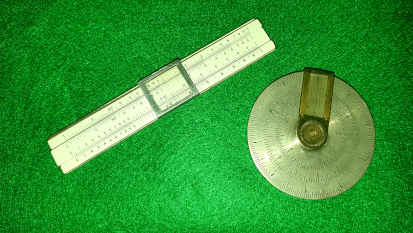
The slide rule took a long time to spread in France. In fact, it was very little known and relatively expensive. Before the 1820s, in France, there were virtually no manufacturers of slide rules. There are only a few instruments that appear to have been made individually, for example the logarithmic rule of Sauveur (1700). Around the years 1800-1810, Gattey's arithmograph was, on the other hand, a real circular slide rule intended to facilitate the transition between the old units of measure and the new metric system adopted by the French Revolution.
In 1829, the slide rule was part of the equipment required for engineering students at the Ecole Centrale, but it was not until 1851 that its use was made compulsory for the entrance exam to Polytechnique, which then trained the vast majority of engineers. According to Lalanne, production was a few hundred per year in 1840-50, 2000 in 1863 and approximately 4000 in 1883. These manufacturers also built many other scientific instruments: theodolites, compasses, sextants, etc.
As an indication, in the 1960s and 70s, the production of each of the largest companies manufacturing slide rules (Faber-Castell, Hemmi, Keuffel and Esser...) was around 1 million pieces per year...

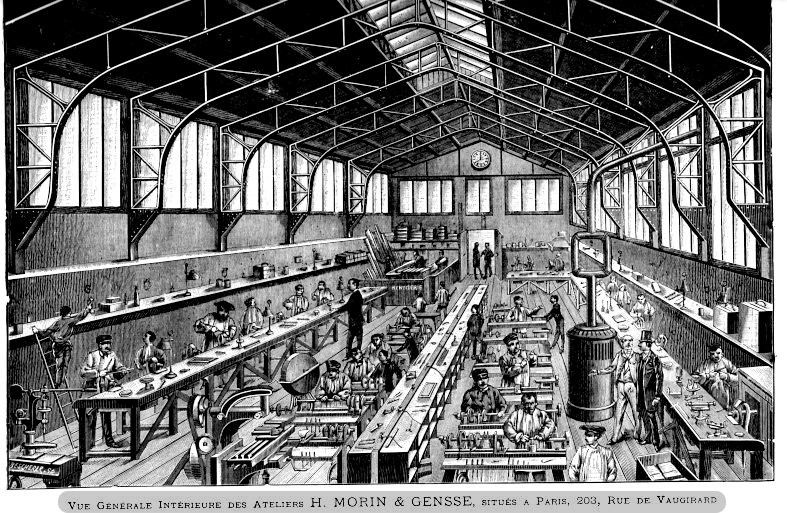
The workshop of H. Morin and Gensse, manufacturers of scientific instruments (catalog engraving of 1895)

Lenoir father and son

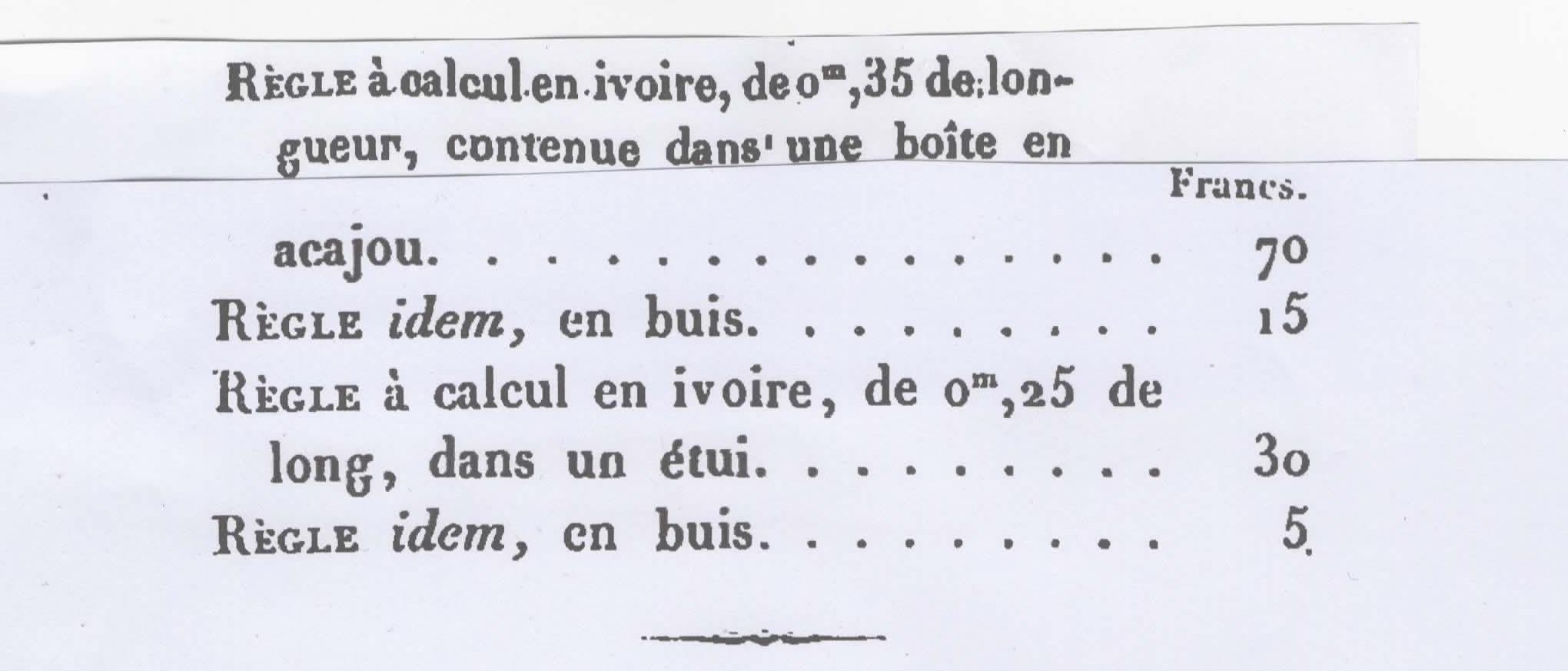
The first rules were made in the workshop of Lenoir around 1820-1825. As indicated by catalog (around 1825-30), he makes two types, 35 cm and 25 cm, some in ivory, so luxury, or boxwood, more affordable.


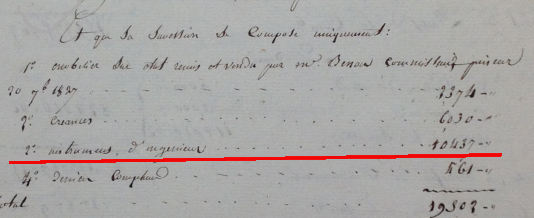
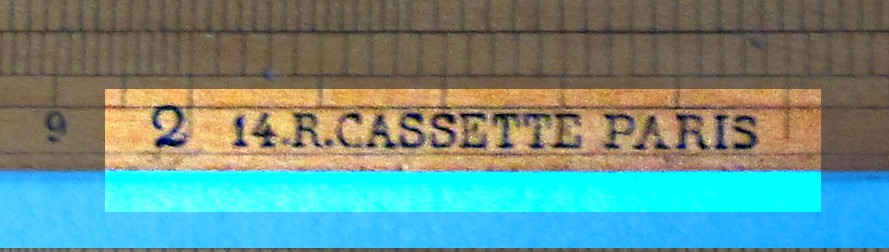
The rules made by Lenoir bear no address, only the signature of Lenoir. At that time, the address was 14 rue Cassette in Paris. The Lenoir workshop closed in 1827 on the death of the son Paul-Etienne, as evidenced by the inventory after death, including the "Instruments d'ingénieur" (engineering instruments) for 10,437 francs which is not found at the death of his father in 1832.


Mabire

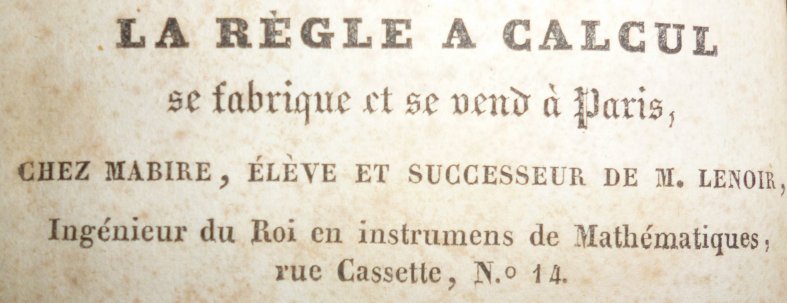
Very little is known about this man. He took over the Lenoir workshop and the trade mark, at the same address, as evidenced by the announcement below, taken from Mouzin’s 1837 instruction manual.


"SLIDE RULE is made and sold in Paris, at Mabire's, Mr Lenoir's apprentice and successor, King's engineer for mathematical instruments, rue Cassette, n° 14 "

This text is ambiguous, because it could suggest that Mabire is a King’s engineer. He is not, Lenoir was. He sold his workshop to François-Fuscien Gravet in January 1839.

Gravet, then Gravet-Lenoir

François-Fuscien Gravet (1812-1895), born in Metz, was the main figure of this period. The name of Gravet appears in the Bottin (Paris directory) as early as 1833, as a glass-maker, then in 1839 as a “manufacturer of Mathematical Instruments” at 14 rue Cassette. It is therefore from this date that he took over the workshop and the Lenoir estate, of which he still uses the trade name.

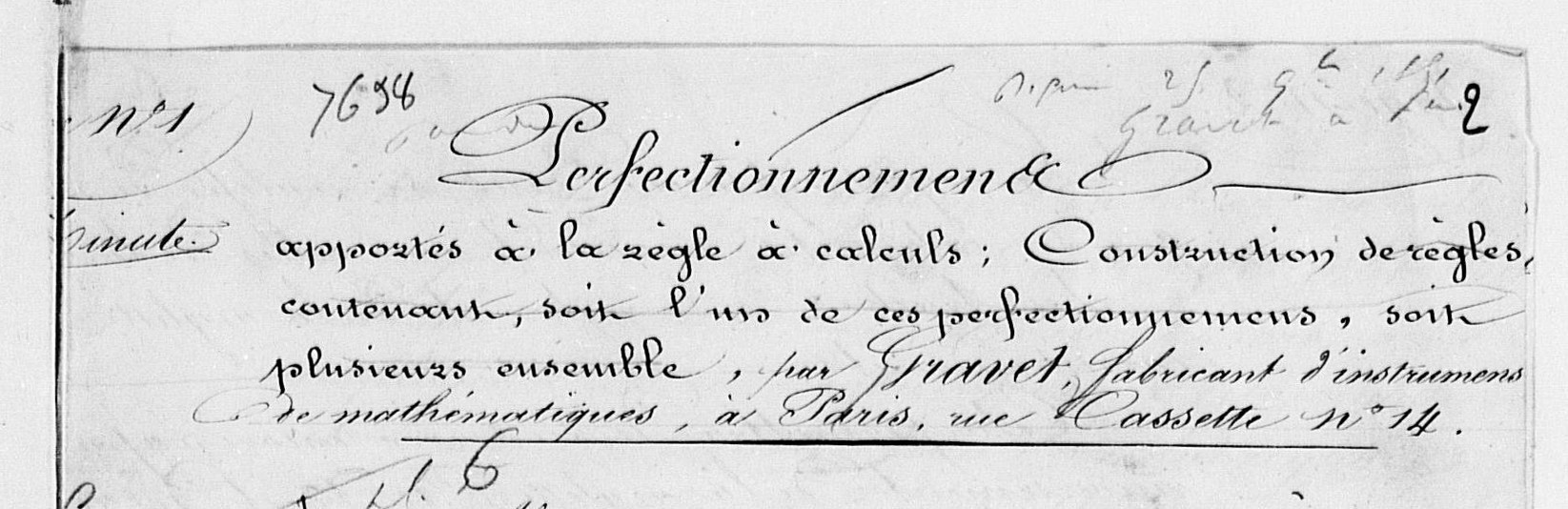
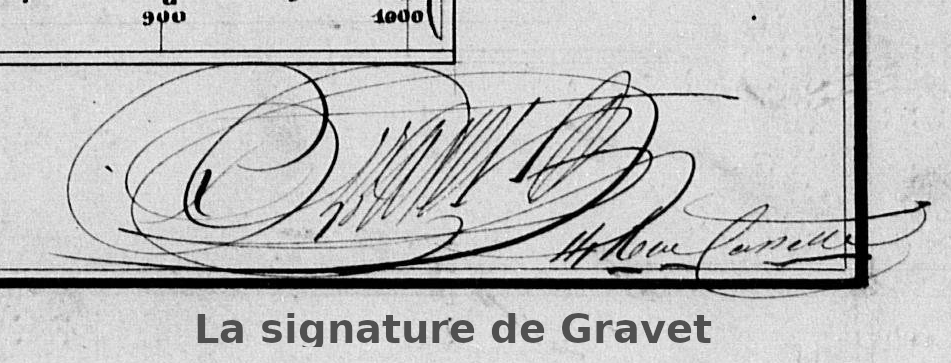
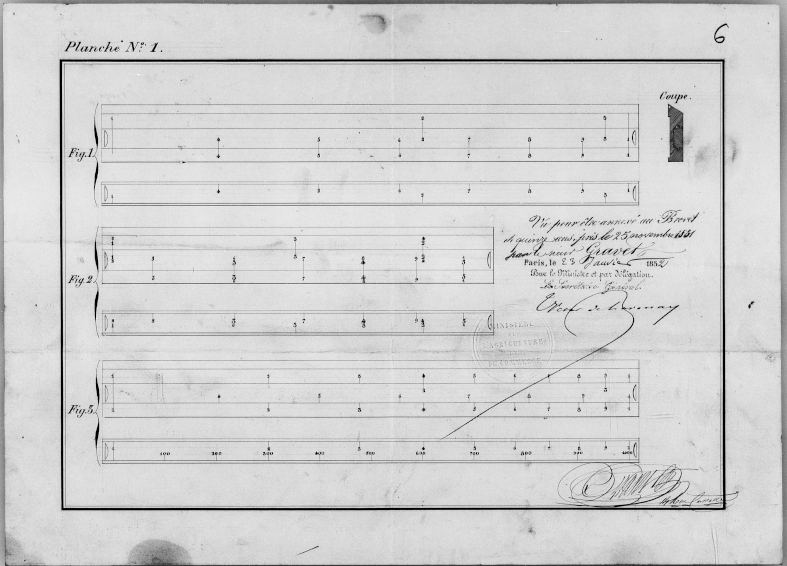
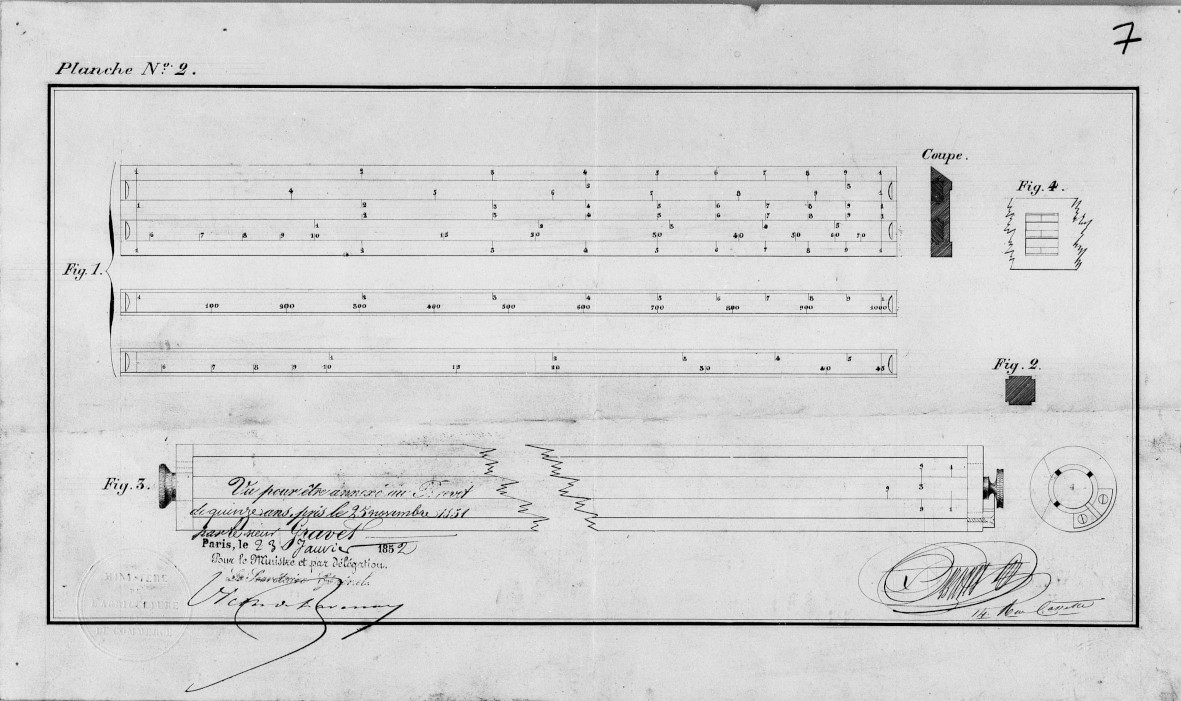
He quickly became known and in 1844, he received a bronze medal on the occasion of the exhibition of products from French industry for a reflective level. In the jury report, we read: “His slide rules are so in favor today that we believe we can dispense with praising them here”. Mannheim will entrust him the task of making the model of rule he invented, for which Gravet will take a patent on November 25, 1851 (no. 12732 dated January 23, 1852). In this patent he describes the new arrangement of scales which characterizes the Mannheim rule.


In this patent he also describes other improvements, in particular a cylindrical slide rule also invented by Mannheim.


Gravet patent
On May 28, 1852, the Paris commercial court ordered him to use the trade name of Gravet Lenoir, following the complaint of a competitor who was also called Lenoir... The rules signed by both Lenoir and Gravet-Lenoir are therefore necessarily from this period: they were manufactured before this judgment and sold after . François Gravet is certainly one of those who contributed the most to the dissemination of slide rules in France at that time.

Tavernier-Gravet

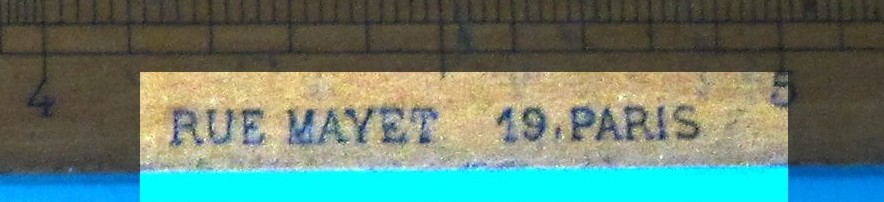
From 1867, the name of Tavernier-Gravet appears, at the same address. What is the reason for this new name ? It’s a family story : Charles Tavernier (1826-1887), who probably worked at Gravet, married his daughter Léonide Gravet on April 20th 1857. marriage certificate
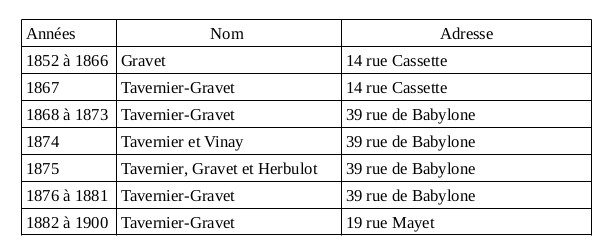
The trade name then becomes Tavernier-Gravet, which will remain with some temporary variations. The table below shows the different addresses up to the end of the 19th century.


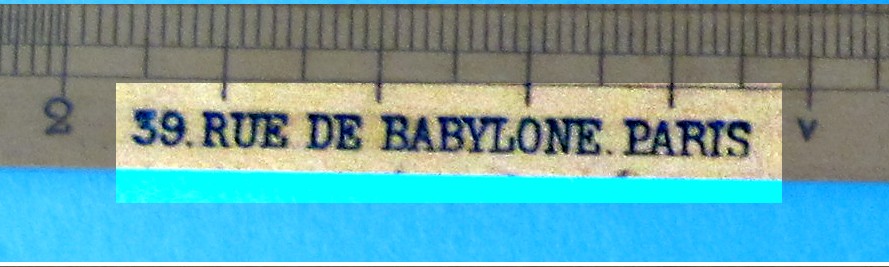
These different addresses allow us to date the rules of this period quite easily.

The Tavernier-Gravet workshop has almost the monopoly of slide rules in France until the end of century. Its instruments are of very good workmanship, and it received three gold medals at the Paris Universal Exhibitions in 1878, 1889 and 1900.
Slide rules are becoming increasingly popular and various models are made, for the topography, wood cubing, navigation and soon electricity etc. Tavernier-Gravet exports some models to the UK, Germany and the USA.
Competition from the German rules will be felt in recent years, and they will take over in the early 20th century, because they were produced industrially by very large companies as Faber-Castell, Nestler, Dennert and Pape.
The Tavernier-Gravet company produced until the middle of the 20th century. However, it was not until the end of WW2 that Graphoplex produced slide rules that could competing with foreign rules. But this is another story…

Some other makers

There were several other smaller manufacturers at the time. However, some made interesting instruments, in particular circular rules, often recalling the shape of pocket watches of that time.
In particular, G. Charpentier, whose "calculimetre", made entirely of metal, forms the logo of the Oughtred Society. Some have been made by Tavernier-Gravet. A. Boucher, from Le Havre, also made watch type slide rules, some of which were exported to England. Finally we must talk about Meyrat and Perdrizet, of Seloncourt in the Doubs, whose circular slide rule is often completed by a watch in the center (or is it a watch with slide rule ?) These circular rules, relatively rare, are often very sought after by collectors.

Home